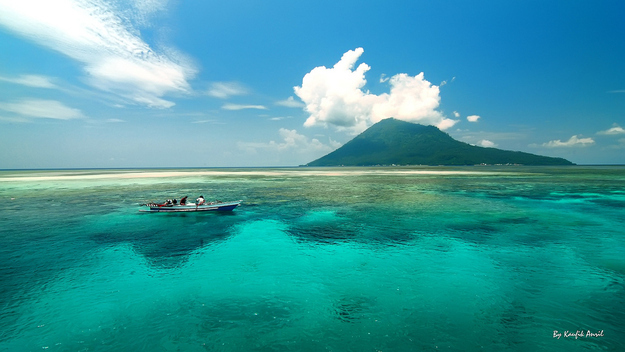
Bangka - Belitung Islands.

Bangka-Belitung is one of Indonesia provinces. It includes two large islands, Bangka and Belitung, and several smaller ones, which lie east of Sumatra, northeast of South Sumatra province. Bangka Belitung (BABEL) Islands province is the 31st Province in Indonesia, one of the newest provinces. Bangka Belitung get it’s approved as a new province in 2001 separated with south Sumatra. That acknowledgement is because of the people struggle. The region that was a great tin mines, now already to reach the new phase in its life. It provisioned with the beautiful of nature, and the uniquely of culture, Bangka Belitung step to the better future.

Supported by the “Serumpun Sabalai” spirit and abundant natural resources, it has been expecting a greater role to speed up the island region's development, namely Bangka regency, Belitung regency and Pangkal Pinang city through cooperation development. That potency of culture and tourism is also supported by its strategic location that can connect with other interesting area. The sea transportation that become the most accessibility in Bangka Belitung Island, is support its economics activities among the Islands.

The richness of Bangka Belitung Island of nature and tin mines until its maritime rich, make Bangka Belitung a magnet for the new comers to get a better life. A Balinese countryside is found in this Island named Giri Jati village, complete with all of Bali culture that remembering us to Bali Island. Beside Bali tribe, we also can found Bugis tribe that adds the various cultures in Bangka Balitung Island. This Bugis tribe can be found in the fishermen village at Tanjung Binga. Otherwise, the original tribe, Melayu culture has strong influence in the traditional ceremony and religious ceremony. One of the ceremonies is Rebo Kasan Ceremony that done by Air Anyer village people. It is believed that one day of a year, the God give His 320,000 angels in the world. The people must together to pray. This ceremony was held in the beach, but now on, it held in the mosque then continued to the beach. Formerly, this ceremony become the people party with its star party is ‘Dambus’ art.

Geographically

Bangka Belitung province is located between 104°50' - 109°30' East Longitude and 0°50' - 4°10' South Latitude, with its total area of 81,724.54 km.

Administrativelly

Administrativelly, Bangka Belitung comprises of 2 regencies and 1 city, namely Bangka regency, Belitung regency and Pangkal Pinang City, of which, the biggest regency's area is Bangka regency with 11,534.14 km area, and the smallest is Pangkal Pinang City, with 89.40 km area.

Climate

There are two seasons that are suitable for sailing to these islands: February-March and October-November, when the wind and the waves are low. The heaviest rainfall is around 2,500 mm per annum with its average temperature between 25°C - 26°C.

Population

In 2001, Babel's population was 920,729 consisted of 462,640 men and 458,089 women. The biggest population among the regencies was Bangka regency, 583,841 people, while the most density population was Pangkalpinang City, with its 1,396 people/km. In 2001, the growth of population reached 1.49 % per annum averagely. Labor. In 2000, its labor force recorded as many as 100,825 people.

Bunaken Island, North Sulawesi


Bunaken is an island of 8 km², part of the Bunaken National Marine Park. Bunaken is located at the northern tip of the island of Sulawesi, Indonesia. It belongs administratively to the municipality of Manado. Scuba diving attracts many visitors to the island.


Other sides of Bunaken.
Bunaken National Park extends over an area of 890.65 km² of which only 3% is terrestrial, including Bunaken Island, as well as the islands of Manado Tua, Mantehage, Nain and Siladen.

The waters of Bunaken National Marine Park are up to 1,566 m deep in Manado Bay, with temperatures ranging between 27 to 29 °C. It has a high diversity of - corals, fish, echinoderms or sponges. Notably, 7 of the 8 species of giant clams that occur in the world, occur in Bunaken. It also claims to have seven times more genera of coral than Hawaii, and has more than 70% of all the known fish species of the Indo-Western Pacific.

Oceanic currents may explain, in part, why Bunaken National Marine Park has such a high level of biodiversity. Northeasternly currents generally sweep through the park but abundant counter currents and gyros related to lunar cycles are believed to be a trap for free swimming larvae. This is particularly true on the south side of the crescent-shaped Bunaken Island, lying in the heart of the park. A snorkeler or diver in the vicinity of Lekuan or Fukui may spot over 33 species of butterfly fish and numerous types of groupers, damsels, wrasses and gobies. The gobies, smallish fish with bulging eyes and modified fins that allow them to attach to hard surfaces, are the most diverse but least known group of fish in the park.

Tiger Island Jakarta


Welcome to Tiger Islands Village & Eco Resort. Life is simple and good here :~) The  two gorgeous islands upon which we have built this paradise exemplify the best of tropical living while introducing modern eco technologies and comforts. The natural environment is stunning and features white sandy beaches, aquamarine waters, colorful corals, playful fish, and lush tropical vegetation. Our food, some of it grown within our organic gardens, is fresh and delicious. Our cabins and structures are simple and comfortable. We’ve got books and DVDs in our media library, and plenty of watersports equipment and island toys. The folks that look after you are from an extended family that have lived on the island for more than 15 years. These friendly, humorous, and innovative staff are your chefs, your housekeepers, your boat captains, your bonfire-builders, your guides, and your friends. Whether you are staying for a weekend or an extended visit, we are always pleased to welcome guests to this tropical paradise. Our vision is to make you feel at home within our beautiful environment, and introduce you to some of the solutions we’ve applied to make our little world a better place. Sustainable energy, environmental stewardship, organic gardening, intelligent waste management, community development, and evolved learning are all part of our life here. When you discover what an amazing vibe results from the combination of these elements, you’ll see why many have called our two little islands paradise :~) Our home is situated within the largest archipelago in the world, off the North West coast of Java, Indonesia, just 88 minutes from Jakarta.

Karimunjawa Islands Jepara

Karimunjawa is and island chain stretching in a northwesterly direction 83 km from Jepara. Central Java. This archipelago is a cluster of 27 islands in the java sea. Only seven of the islands are inhabited. The reefs are a mixture of fringing, barrier, and patch with bottom depths ranging from 15 to 40 meters. The name of Karimunjawa is taken from Javanese language 'Kremun kremun saking tanah Jawi' addressed by one of Wali Songo (the Nine Saints who had introduced Islam in Java) to describe how far this mini archipelago from Java, to be exact from Semarang and Jepara. Stands from 27 islands, this mini archipelago became marine national park and it's like a treasure for those who love marine life. Here can be found protected coral reefs (very colorful plateaus and plains in deep and shallow waters), secluded and tranquil white beaches, pelican and hornbill, sea grass and kinds of sea creatures, from crabs, anchovy, starfish, sharks, stingray, jellyfish, red snappers, etc.

The Marine National Park Karimun Jawa is 110,000 ha and lies 90 km north east of Jepara in Central Java. We will find mangrove forest and beach forest. The park is named after the largest island Karimun Jawa. The vegetation consists mainly of mangrove and beach forest, although there is some lowland rain forest on Karimun Jawa. Most of the islands are surrounded by sandy beaches and fringing coral reefs. Fresh water is confined to a few small wells and forest streams on Karimun Jawa. A number of endemic animals live on the island while on the beaches sea turtles lay their eggs. The average tidal range is 92 cm.

The archipelagic Karimunjawa, thought not as known the Marine reserves near Ambon and Manado, has unexpectedly good beaches, reefs and lovely sea scopes. Corals seem to blossom in to gardens, with an Amazing variety of form and color fishers and marine plants. It lies 90 km away from Jepara and can reached by "KM. Adison I & KM Kota Ukir" boat, the only ferryboat connecting Karimunjawa and Jepara. The resort offers stunning dives and snorkeling trips for all sorts of divers from novice to experience. Fringing reefs, atolls, wrecks and an excellent variety of different species make diving in Karimunjawa an unforgettable adventure.

Alor Island

Alor (Indonesian: Pulau Alor) is the largest island in the Alor Archipelago located at the eastern Lesser Sunda Islands that runs through southeastern Indonesia, which from the west include such islands as Bali, Lombok, Sumbawa, Komodo, and Flores.

To the east of the island across the Ombai Strait lie the islands of Wetar and Atauro, the latter belonging to East Timor. To the south, across the Strait of Alor, lies the western part of Timor. To the north lies the Banda Sea. To the west lies Pantar and the other islands of the Alor archipelago, and further yet the rest of the Sunda Islands.

Alor is one of the 92 officially listed outlying islands of Indonesia.

On 12 November 2004, an earthquake measuring 6.0 on the Richter scale occurred, killing 34 people.

Alor has an area of about 2800 km², making it the largest island of the Alor archipelago.

Kalabahi is the only town on the island of Alor, with a metropolitan population of about 60,000. The variety of goods obtainable in Kalabahi is surprising considering its size and location. The 2010 census population of the island is 145,299 out of 190,000 in the regency.[1]

Alor is of volcanic origin and has very rugged terrain. The region near Kalabahi is the only flat area. This is why the Dutch placed the capital and the main harbor (Alor-Kecil) of the area here in 1911.

"The best" snorkelling and diving in Indonesia can be found in the Alor archipelago. Due to intriguing and often very strong currents it is best to snorkel or dive with someone who knows the area well. Transportation to Alor by TransNusa Trigana Air, from Kupang, Denpasar and Surabaya.

The island's infrastructure is only weakly built. The inhabitants practice mainly subsistence agriculture. The government seeks to change this with the help of international organizations. In the villages, vanilla, tamarind, almonds and other nuts are cultivated. In the forests sandalwood is cut down for trade.

The latest geological explorations have discovered valuable resources such as gypsum, kaolin, petroleum, natural gas, tin, gold, and diamonds.

Alor's highly esteemed snorkeling and diving promise an increase in tourism in the future. Depletion of the fisheries has however damaged the coral reefs in recent years.

More than 15 different indigenous languages are spoken on Alor, the majority of them classified as Papuan or non-Austronesian. These include Abui, Adang, Hamap, Kabola, Kafoa, Woisika, Kelon, and Kui. In addition, Alorese (Bahasa Alor; ISO 639-3: aol) is a Malayo-Polynesian language which is spoken along the coast of the western and southern Bird's Head of Alor Island and in places on surrounding islands.

Many of the Papuan languages of Alor are endangered and are no longer being actively acquired by children. Some languages have fewer than 1000 speakers remaining. Significant linguistic documentation efforts have been undertaken recently by Leiden University.

The language of daily communication is Alor Malay, a unique Malay variety with some similarities to Kupang Malay. Indonesian is taught in schools and used widely in media.

Transportation[edit]
During the dry season, Kalabahi is serviced by flights five times a week from Kupang the provincial capital, using a [ATR42] 46 seat by TransNusa Trigana Air and Kasa[disambiguation needed] 18-seat airplane. These flights are run by Merpati Airlines. Most of them are simply Kupang–Kalabahi–Kupang, but mid-2003 a new flight Kupang–Kalabahi–Kisar–Ambon, returning the next day, was introduced. The two Pelni passenger ships Serimau and Awu also pass through Kalabahi each week. Transport to Alor during the wet season is sometimes disrupted due to high winds and large waves.

On 17 November 2006 Trigana Air suffered its first ever plane crash accident. The aircraft (a de Havilland Canada DHC-6 Twin Otter 300) struck a mountain in Puncak Jaya (Indonesia) seven minutes before it was scheduled to land in the remote Indonesian province of Papua. All 12 passengers on board died shortly after the incident.

Alor island has its own airport.

HIDDEN PARADISE: THE DERAWAN ISLANDS


Quite surely, most of you have never heard of this beautiful place, but the Derawan Islands in Indonesia have taken my heart by storm. Not as famous as other destinations in Indonesia, they still have a lot to offer. They are located just off the east coast of Borneo (also named Kalimantan by the locals) and comprise dozens of islands. I visited four which are also the most popular among them: Derawan, Maratua, Kakaban and Sangalaki. Each has its own way of stealing your heart and making you never want to leave again. Here is how:

Derawan is the main island and quite a lively one, with many locals living in homes on stilts over the turquoise sea water. In a way it feels pretty crowded, especially in comparison to the other islands, but the bustling atmosphere is what makes it so special. More people also bring more pollution and the waters here are not as clear as elsewhere. However, while you won’t find the best spots for snorkelling and diving, you will without a doubt discover the best spots to encounter the local culture.

Wander around the island and learn to pay close attention to the hidden beauty of your surroundings: the colourful houses, laundry hanging out to dry, shops with local curiosities or kids playing in the streets. The island is not very big, so exploring on foot is definitely possible, but there are also bikes for hire. A must-do is to visit a local fisherman when he rests in his boat or prepares to head seawards – they love to talk and tell the greatest stories about the sea and the island.


One thing not to miss is the golden sunset, when the sea and sky are glooming and sparkling in all shades of gold. Watch it from the shore, the pier or if you’re lucky from your ocean view terrace.

Derawan is a great place to base yourself as many fishing boats and speed boats to the other islands leave from here. There is a wide range of accommodation available, from budget to luxurious. I’d recommend to go for a homestay of which there are several on the island, and choose between renting a small bungalow by the beach or staying in a local’s house.


Maratua Island: The Quiet One

If you seek tranquility and privacy then Maratua is an ideal choice, even though it is the biggest of the Derawan Islands. There is an exclusive resort, the Maratua Paradise Resort, located in a big lagoon and surrounded by crystal-clear shallow water and white sandy beaches. Needless to say, snorkelling and diving is on top of the list of things to do when setting foot on this gorgeous island. Here you can also expect to see the sea turtles and if you’re lucky you get a chance to swim with them!


Kakaban Island: The Home of the Jellyfish

Kakaban is known as one of the best spots for snorkelling and diving in the Derawan Islands and even all of Indonesia. It is the home of the stingless jellyfish, so no worries about swimming in their waters. The island’s lake is busy with four different species of the harmless jellyfish, of which some you can only find in one other place in the world (on Palau Island, Micronesia). One in particular is quite interesting, but very hard to spot – locals call it “the invisible one”. It is not allowed to use sunscreen or sunblock to protect your skin when snorkelling in this lake, as the chemicals would poison the jellyfish. You are advised to wear a t-shirt or rash guard instead.


Out of the lake, into the sea: snorkelling near the jetty area of the island is just as exciting. There are mesmerizing corals, fish in all shapes and colours and many other beautiful sea creatures.

Getting here is quite easy: speed boats leaving from Derawan take about one hour to reach Kakaban and cost roughly $80 for four passengers.

Sangalaki Island: The home of Manta Rays and Sea Turtles

While Kakaban Island is best known as the home of stingless jellyfish, Sangalaki is famous for its manta rays and sea turtles. The island can be reached from Derawan by boat (2 hours on a fishing boat, a lot faster with a speed boat). The Green Turtle Conservation centre managed by WWF and the local government is the biggest of its kind in Asia. Visitors can watch turtles laying their eggs and see baby turtles getting ready to be released back into the sea.

The best dive spots on the island are Manta Parade, Sherwood Forest and Coral Gardens – with a bit of luck you can dive with turtles and manta rays here!


Admittedly, getting here is quite a trek (make your way to Berau by plane, onwards overland to Tanjung Batu or Tanjung Redeb and from there reach the islands by boat) but the pristine waters, amazing snorkelling and diving spots and one-of-a-kind wildlife encounters make it worth the effort. Definitely put this down for your Indonesia itinerary!

Labels

Bay (1) Beach (6) Cave (1) Islands (6) Lake (1) Mount (1) Park (2)